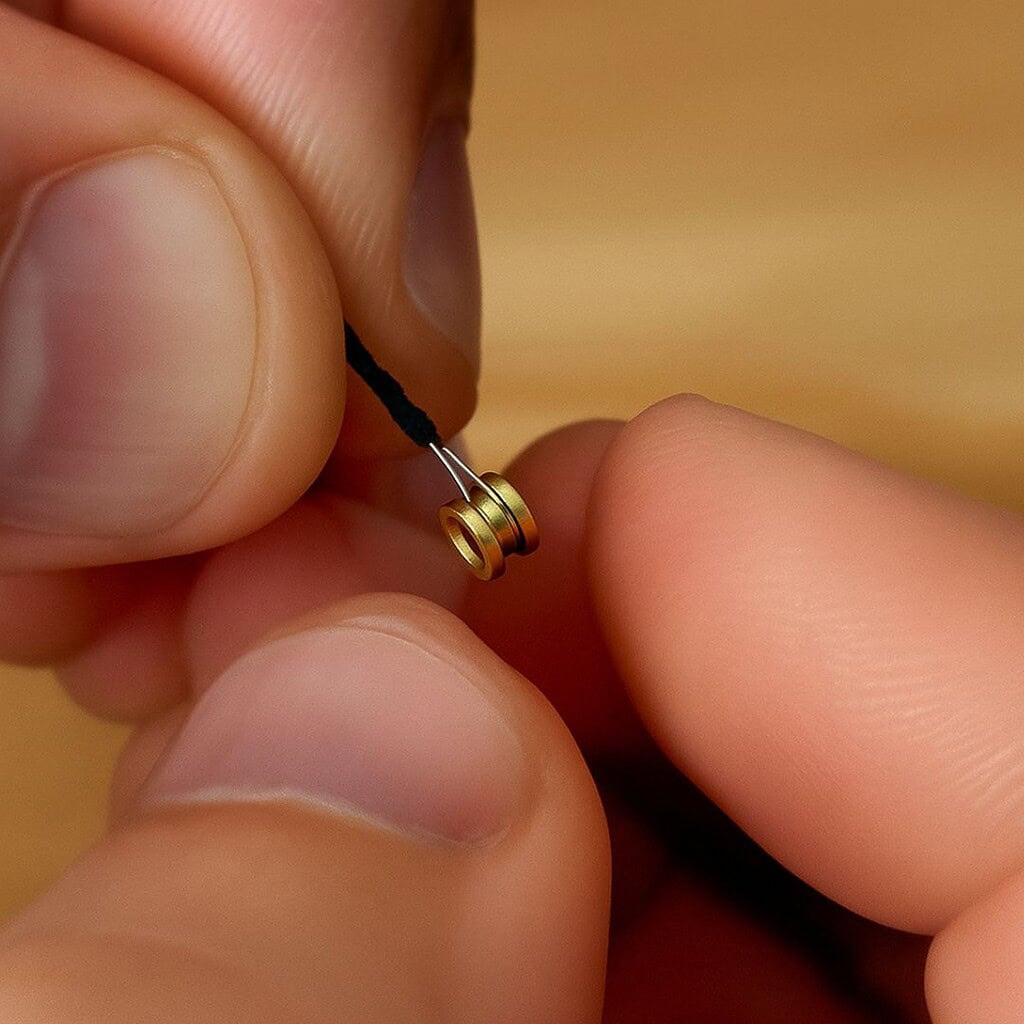
For many years, around 80% of our E string sales were the ball-end version. Traditionally, the choice between a ball-end vs. loop-end E string was often seen as a matter of personal preference or aesthetics. However, our experience has shown that the difference is not only visual—it can also affect the sound of the instrument.
The Role of Afterlength
The acoustic difference between loop-end and ball-end E strings is mainly caused by the afterlength of the string: the short segment of the string between the bridge and the tailpiece.
When a loop-end E string is used with a so called Hill-type fine tuner attached to the tailpiece, the afterlength is longer than with a ball-end E string. This longer afterlength produces a slightly lower and more intense resonance, which can contribute to a warmer and more projecting overall sound.
In contrast, a ball-end E string connected to a standard fine tuner usually results in a shorter afterlength and therefore a slightly different tonal response.
The weight of the fine tuner also plays a role. Any additional mass attached to the string can dampen its vibration and reduce resonance. For this reason, lighter solutions—such as Hill-type tuners for loop-end E strings—are generally more acoustically efficient.
What About Integrated Tailpieces?
If your violin has a tailpiece with built-in fine tuners, the tonal difference between loop-end and ball-end E strings is generally smaller, especially if the tailpiece is lightweight.
To achieve the best sound from your instrument, we usually recommend:
- using a loop-end E string with an English-style fine tuner, or
- using a ball-end E string with a lightweight integrated tailpiece of good quality. If you are using Warchal Amber, Timbre, or The Beast E strings with a helix, we recommend choosing the IFT (Integrated Fine Tuner) version when pairing them with a tailpiece that has built-in fine tuners.
How Noticeable Is the Difference?
The tonal difference between between ball-end and loop-end setups is not dramatic, but it is noticeable. Many players can hear the change, and it can also be measured using a spectrum analyzer.
In general, a loop-end E string used with a lightweight fine tuner can offer a slightly more open, resonant, and responsive sound compared to a typical ball-end setup.
When combined with other small setup improvements (for example replacing a nylon tailgut with a Kevlar-type tailgut), these subtle changes can contribute to a clearer and more responsive sound.
Durability: Are Loop-End E Strings More Fragile?
Loop-end E strings were once considered less durable because of occasional breakage at the loop. In most cases, however, this happens when the string is used with an inappropriate fine tuner.
With a properly designed fine tuner, loop-end E strings are perfectly reliable. To avoid problems, we recommend following the correct loop-end fine tuner setup.
Need a Loop-End Instead of a Ball-End E String?
If you find yourself needing a loop-end E string but only have a ball-end version available, there’s a simple solution. In many cases, the ball can be safely removed to create a loop-end. We’ve prepared a short video showing exactly how to do it:
👉 Need a loop end instead of a ball end?